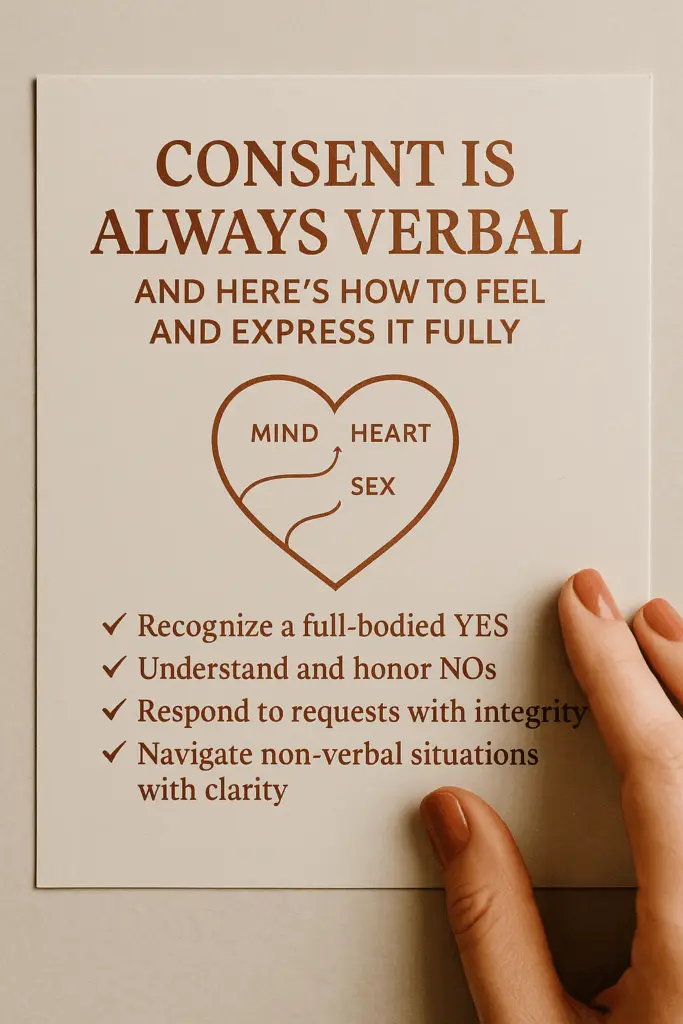
 What Is a Full Embodied YES?
A real YES isn’t just words — it’s felt alignment in the whole system:
Sex center: Arousal and desire
Stomach: A sense of safety and ease
Heart: Openness, warmth, and connection
Mind: Clarity and willingness
A true YES needs to be present in all four.
If it’s only the sex or the mind — it’s not a YES.
If there’s hesitation or confusion — it’s a NO.
 “If you’ve never felt a full embodied yes, you won’t be in doubt once you do. It’s unmistakable. Until then, start practicing by making love to yourself — physically, emotionally, spiritually.”
This embodied alignment is something we train in every Temple Night. Because we believe that navigating your Yes’s starts with radical honesty — not with others, but with yourself.
 What Is a NO? (And Why It’s a Gift)
A NO is not rejection.
A NO is truth.
And truth is sacred.
When someone gives you a NO, you can trust their YES even more. That’s why a NO is a gift — it clears the space, builds trust, and sets everyone free.
“Thank you for taking care of yourself” — is the sacred response to every NO.
Whether someone says:
“No, I’m not open to that”
“No, not right now, but maybe next week?”
“No, thank you — but I’d love to connect in another way…”
Each of these are clear boundaries. Honor them. Believe them. Don’t try to negotiate or perform to change them.
 Redirects like “not now, but maybe later” should only be used if they are 100% true and clear. Otherwise, they blur the sacred line between YES and NO — and that erodes trust.
 How to Respond to a Request (Consent in Practice)
When someone makes a request, here are your options:
1. Full YES
“Yes, I’d love that.”
2. Full NO
“No, I’m not open to that. Thank you for asking.”
3. NO with Redirect (if sincere and specific)
“No, not that, but I’d love to [suggest something else].”
“No, not now, but let’s connect again [suggest sometime else].”
 And always remember: If you’re not sure — it’s a NO.
No shame. No justification needed.
 What About Non-Verbal Consent?
There is no such thing as non-verbal consent.
According to Danish law in regards to sex — and Temple Night principles in general — consent must be clearly verbalized. That means:
Eye contact ≠ consent
Open arms ≠ consent
Smiling ≠ consent
Nakedness ≠ consent
If someone moves toward you with a hug and you’re unsure? Step back.
If someone puts a hand on you without asking? Gently remove it. Say:
“No thank you.”
“I’m not a yes to touch right now.”
“Can you ask before touching me?”
 These are simple tools of clarity — and they build a foundation for true, sacred relating.
 Your Consent Toolkit
When asked something, try these responses:
 “Yes, I’d love that.”
 “No, thank you.”
 “Not that, but I’d love to [something else]”
 “No, not now. Maybe [specific time]?”
 “Thank you for taking care of yourself.”
When you’re unsure what you feel:
Pause.
Breathe.
Ask yourself: Do I feel open in my heart, calm in my belly, safe in my body, and clear in my mind?
If not — you’re allowed to say:
“I’m not sure yet, so it’s a no for now.”
 This Is the Foundation of Sacred Love
At Temple Nights, consent isn’t just a rule. It’s a ritual of reverence. It’s how we create spaces of trust, play, pleasure, and healing. And it begins with you being in truth — even if that truth is a vulnerable NO.
So start there. And return there. Again and again.
 For more tools on conscious relating, explore the RBDSMT Conversation Guide — a core practice in our temple trainings.